
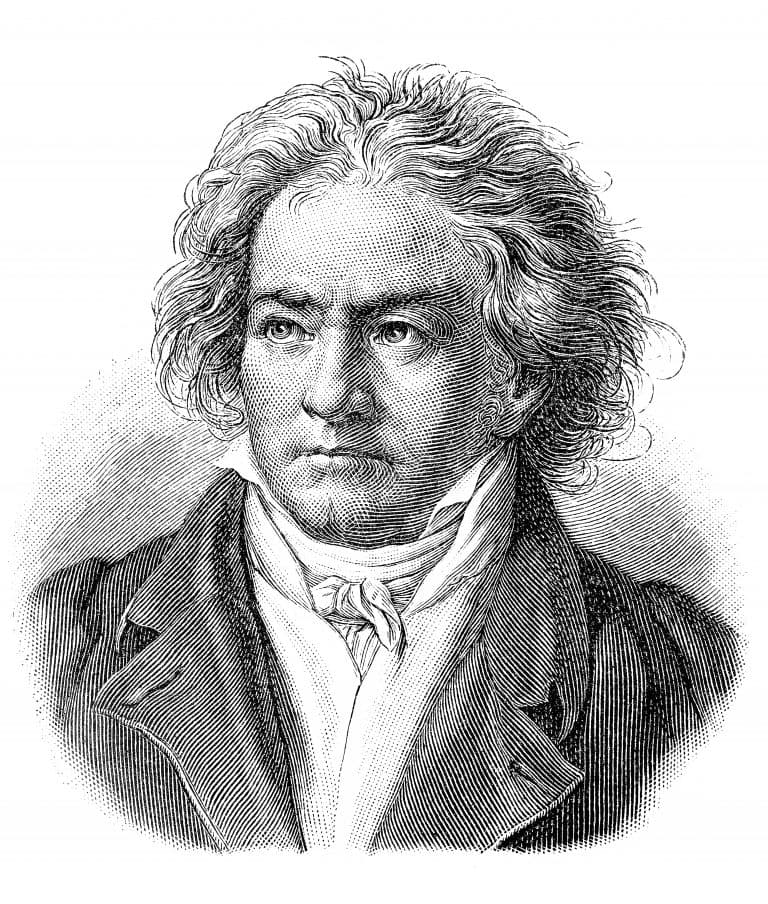
More than an elective affinity, Schiller and Beethoven share an artistic kinship. They live in a similar world, and across the distance they carry on a dialogue with one another as equals. At 26 the poet wrote his Ode An die Freude (1785), which the composer most probably discovered at 22, in 1792. In those years Beethoven's home city of Bonn was a centre of the Enlightenment. There one could find books that elsewhere were regarded as „dangerous" by enemies of the Enlightenment. In this cultural setting Beethoven was able to be introduced to the works of Voltaire, Rousseau, Goethe, Schiller, Kant and the Ancient Greeks.
Equally important is the symbiotic mingling of symbols and allegories that, at the close of the 18th century, shaped the Age of Enlightenment. The chief foundations of this symbiosis lie in Freemasonry. After the violent upheaval caused by the French Revolution of 1789, the lodges at the beginning of the 19th century had fallen into turmoil.
Under such circumstances it is hardly surprising to find strong Masonic influences in the text. This is probably also owed to the fact that the friends Schiller visited in Dresden and Loschwitz were Freemasons. Quite naturally his poem was taken up and sung in the lodges. Yet one must emphasise that — quite apart from Freemasonry — the message of the Ode An die Freude was an echo of its time. Around 1810, in Bonn, under the influence of the Revolution across the Rhine, even the students sang the Ode to the melody of the Marseillaise.
It is worth noting in passing that, although both artists show a clear assent to the chief principles of Freemasonry, neither one nor the other ever belonged to this society. This was confirmed to us shortly before his death by the eminent historian and Freemasonry specialist Philippe A. Autexier. There is no doubt that both artists drew inspiration from Masonic principles. Yet despite this affinity, they always remained outside the society.
Schiller originally conceived an Ode An die Freiheit — an Ode to Freedom. The shift to „Freude" (Joy) is to be understood as an extension of the Ode's intent. If freedom is to constitute the chief foundation of human destiny, then joy forms the full unfolding of that destiny. Around 1803 Schiller reworked his text anew. On this new version Beethoven built the magnificent music-and-word complex of the 4th movement of his last symphony. In doing so he himself made important alterations and added an entire strophe by way of introduction.
Beethoven's inventive work on Schiller's text is striking and forms a harmonious whole. In part the order of the strophes is rearranged, whole passages are cleared away, and sections suited to repetition are carefully selected. Yet Beethoven is always intent on concentrating on the essential, and on working out his plan as a structural element of the score. Thus, for example, he clears away the ponderous epic allegorising that the Freemasons of the time so loved. He takes only universal symbols, expressing no relation to a particular era. In this regard one must single out the symbolic meaning of one of the few allegories preserved in its original sense: the „Daughter of Elysium". For Schiller she is quite clearly the affirmation of a belief: the striving of human beings for fellowship will lead the political states to come together in a harmonious world founded on reason.